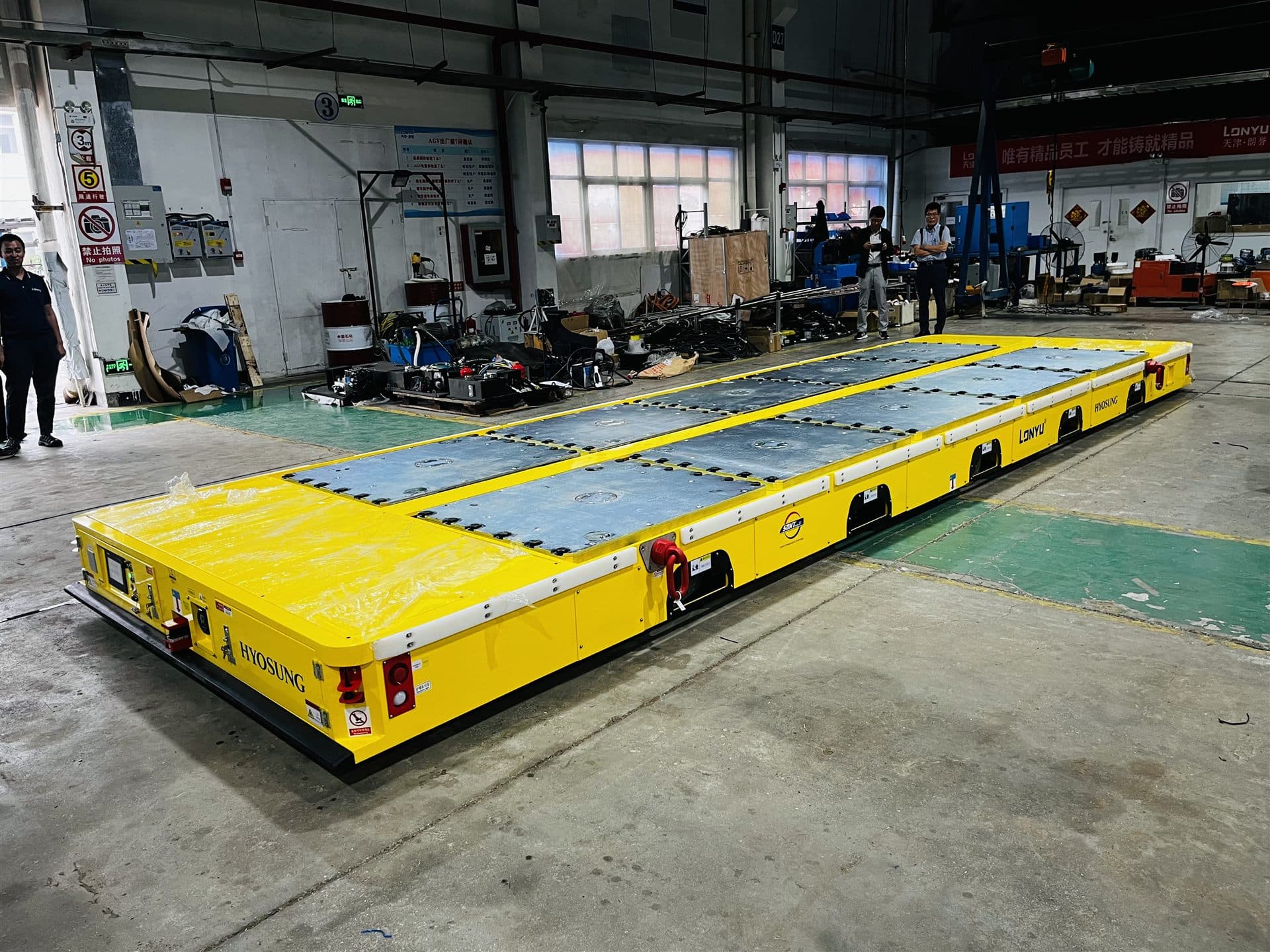
Heavy-duty AGV platform in a workshop

Product Families

The Lonyu Robot range is organized into four main families. The right vehicle is configured per project around your load, route and site conditions.

01

Heavy-Duty Automated Guided Vehicles (AGVs)

Project-configured AGV platforms for controlled movement of heavy, long, or oversized loads between defined tasks and process stations.

This family may include flat-platform, partial- or full-lift, under-load, omnidirectional, or synchronized-vehicle architectures according to load geometry and site conditions. Body, drive arrangement, lifting interface, navigation, safety, and charging are selected together; no option should be treated as standard across every payload and application.

How it differs from the other families: Unlike a trackless transfer cart, the defining principle is task and route automation rather than simply being rail-free. Unlike an outdoor AGV, environmental hardening is not assumed across the family; unlike a mould-transfer system, it is not tied to one mould or rack interface.

Typical applications

Transformer bodies and active parts; wind components; energy equipment and large cabinets; heavy castings or machinery parts; long loads or loads requiring dedicated support.

Typical industries

Transformer and power equipment; wind energy; heavy industry and machinery manufacturing; metals; rail and specialized-equipment manufacturing.

600-ton transformer transport — synchronized dual AGVsWatch on YouTube
Precision-docking bogie transport — 6-ton AGVWatch on YouTube
02

Trackless Industrial Transfer Carts

Transfer vehicles for heavy material movement on suitable factory floors or yard routes without fixed rails, with control and automation level defined by the project.

The official family covers battery-powered rail-free vehicles with a strong emphasis on remote-controlled steering, while some product names also use 'automatic' or 'AGV'. Being trackless therefore does not by itself imply autonomy. Platform, steering, load interface, environmental protection, and automation level must be confirmed for the actual model and project.

How it differs from the other families: It differs from the heavy-duty AGV family because the primary classification is rail-free, steerable transfer rather than task automation. Outdoor or mould-transfer capabilities may overlap in individual projects but do not define the whole family.

Typical applications

Heavy mould and coil transfer; large equipment or machinery parts; warehouse-to-production movement; cross-workshop transfer where conditions permit.

Typical industries

Heavy manufacturing; metals and foundry; wind equipment; warehouse and assembly operations; large machinery manufacturing.

03

Outdoor Unmanned AGV Systems

AGV systems configured for environmental, ground, and navigation conditions to provide unmanned material flow across factory campuses, inter-building roads, and outdoor routes.

This family covers carriers intended to execute automated tasks outdoors. The Product Dictionary includes park-logistics and container-transport examples plus some indoor/outdoor configurations. No 'all-weather' claim should be used until protection, temperature, precipitation, drainage, road surface, gradient, traffic, communications, and positioning are verified for the project.

How it differs from the other families: It differs from the general heavy-duty AGV family because outdoor and inter-building automated operation are primary design inputs. Unlike a trackless transfer cart, unmanned tasks and outdoor navigation are central; it is not merely a rail-free platform.

Typical applications

Cross-workshop transport; factory-campus and outdoor-storage flow; transfer of metals, rolls, pallets, ladles, or heavy components; container and port logistics in suitable projects.

Typical industries

Heavy manufacturing; metals; construction machinery; photovoltaic and energy equipment; food logistics; port and industrial-campus operations.

Aluminium ladle transport — outdoor AGVWatch on YouTube
AGV capability tests — auto dispatch and 8° slopeWatch on YouTube
04

Automatic Mould Transfer Systems

Project-specific automation systems for driving beneath a mould or rack, engaging its load interface, and transferring it between process zones.

The official family describes an AGV-based system that drives beneath a purpose-built legged rack, lifts at the appropriate position, and moves a mould between process zones. The Product Dictionary does not use the same official name as a separate group; its flat movers for moulds/sand boxes and special-shaped fixture AGVs overlap only partly. Lift, drive, rack, heat/dust protection, and process sequence must not be presented as one standard product.

How it differs from the other families: It differs from the other three families because it is a transfer system in which the vehicle, mould, rack/fixture, lifting interface, and station flow are designed together.

Typical applications

Casting-mould or sand-box transfer; flow between mould buffers and process stations; press, casting, or injection-mould feeding/changeover; special-rack and fixture transfer.

Typical industries

Foundry; heavy machinery manufacturing; press and forming; casting and injection moulding; specialized production lines.

450-ton casting sand-box transportWatch on YouTube

Project Evaluation: The Questions That Define Configuration

No vehicle is selected from a tonnage figure alone. The topics below are the shared inputs that define configuration across all four families; we clarify them together in a discovery discussion.

01

What are the load's normal and maximum weight, length, width, and height?

Body, drive, wheel, and lifting architecture cannot be selected from nominal payload alone.

02

Where are the load's centre of gravity, support points, and permitted contact zones?

These determine stability, platform size, wheel loads, and the lifting/restraint interface.

03

How will the load be picked up, supported, restrained, and released at origin and destination?

This determines direct-deck, under-rack, partial/full-lift, or special-fixture selection.

04

What are the route length, aisle and door widths, turning areas, intersections, and loaded sweep envelope?

Vehicle size, steering/manoeuvring arrangement, and traffic approach are selected with route geometry.

05

What are the floor capacity, flatness, surface material, joints, channels, and local defects?

These affect wheel loads, vibration, stopping distance, ground clearance, and any floor-improvement need.

06

What gradients, ramps, thresholds, level changes, and gaps occur on the route?

They affect traction, braking, ground clearance, suspension, and load-security limits.

07

Will the vehicle work indoors, outdoors, or across both; what temperature, precipitation, dust, humidity, drainage, and contaminants apply?

Protection, sensors, navigation, materials, and operating limits are verified for the environment.

08

What positioning/docking tolerance is required at each station, and how will acceptance be tested?

Navigation, station references, and mechanical interface cannot be selected from one generic accuracy value.

09

What are the hourly/daily cycles, loaded and empty routes, target time, shift pattern, and waiting periods?

Speed, fleet size, battery, charging, and availability targets are calculated from the actual duty profile.

10

What manual or automatic charging expectation, available charging windows, power infrastructure, and charging locations apply?

Charging is sized with the vehicle, duty cycle, and site infrastructure; not every method is available on every vehicle.

11

Will operation be manual, remote-controlled, automated, or mixed; which stations, doors, weighing, task, or production systems must communicate with it?

Control architecture, interfaces, protocols, network, and responsibility boundaries must be defined at project start.

12

What pedestrian and vehicle traffic, safety zones, visibility constraints, emergency stops, load risks, and site rules apply?

Sensor layers, speed zones, stopping distance, traffic control, and acceptance criteria are selected from the risk assessment.

Let's Discuss Your Application

Not sure which family fits? Share your load and route, and we will identify the right family and configuration together.

Contact Us